

Perspectives
Keep
Reading

Domestic Equity Market Commentary – 3Q 2026
Domestic Equity | InsightGW&K’s domestic equity team reviews a narrow and volatile third quarter and considers the outlook for earnings, interest rates, and AI-driven growth.
Read Article
Domestic Equity Market Commentary – 2Q 2026
Domestic Equity | InsightStrong earnings, AI investment, and resilient economic data supported equities during the second quarter as our team remains focused on identifying high-quality businesses for the long term.
Read Article
Building Durable Growth Through Discipline and Research
Domestic Equity | InsightAs investors look beyond the largest companies for growth opportunities, small and mid cap equities continue to offer a broad and dynamic investment landscape. Joe Craigen discusses the team’s long-term, bottom-up approach to investing and thoughtful risk management across market cycles.
Read ArticleThis Website Uses Cookies
We use cookies to improve your experience on our website. To accept cookies click Accept & Close, or continue browsing as normal. For more information or to learn how to opt out of cookies, please see our cookie policy.
Accept and Close-
Latest Insight
Why Investors Should Look Forward After the Recent Muni Selloff
Municipal Bond
Municipal bonds have come under pressure as yields rose. Explore what’s driving the selloff, how higher starting yields may affect returns, and how investors may benefit.
Read Article
Domestic Equity Market Commentary – 1Q 2026
The market’s string of consecutive quarterly gains ended at three, with Operation Epic Fury and its related shock to energy prices resulting in an official correction from late February’s highs. The S&P 500 posted a decline of -4.33% for the quarter. The lack of a quick resolution to the conflict weighed on equity markets, as did the resulting backup in inflation expectations and interest rates. Private credit issues and worries about AI-driven disruption also pressured markets during the quarter. The Supreme Court’s ruling overturning Trump’s tariffs did not impact markets as it was quickly followed by replacement tariff initiatives under other legal authorities. With oil prices topping $100 per barrel, Energy stocks soared, gaining 38%. Solid gains were also registered by an eclectic mix of sectors including precious metals-heavy Materials, and defensive Utilities and Consumer Staples. Financials were weak on both higher interest rates and AI disruption fears, while Information Technology wasn’t far behind on similar AI concerns.
The broadening of equity market returns was evident in the quarter, as the Russell 2000 eked out a gain of just 0.89% for the quarter. However, its drop from January highs also put it in correction territory. Energy was also the top performer among smaller cap constituents, with its 38% return right in line with large caps. While defensive sectors also posted gains, they were outmatched by returns in Materials and Industrials, both driven by industries that should benefit from the massive buildout of AI infrastructure. The Information Technology sector posted losses driven by continued quantum-computing weakness as well as AI disruption fears impacting software names, while losses in Consumer Discretionary were driven primarily by disappointing earnings among smaller retailers. Style factors had a mixed impact on smaller cap names, with a slight benefit to higher-quality attributes.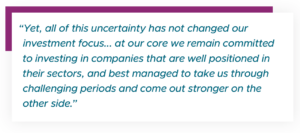
Large cap value stocks had a huge performance advantage over growth to start the year, outperforming by nearly 12 percentage points. Value stocks in all market sectors outperformed their growth counterparts, although the largest impacts were driven by the value-heavy Energy sector’s huge gains and the growth-heavy IT sector’s broad losses. Among small cap stocks, the differential was not quite as dramatic at nearly 8 percentage points, with Energy and IT again having the biggest impacts.
While we were correctly optimistic on the broadening of stock market returns entering the new year, and on the positive outlook for earnings, we surely did not anticipate the war in Iran and its impact on energy prices, inflation, interest rates, economic growth, or geopolitical stability. The ultimate timing of any resolution of the conflict, or even a de-escalation in rhetoric and normalization of traffic through the Strait, will likely be the primary driver of both the economic and stock market outlook. We have no better insight than that of the many pundits we hear from every day. So rather than speculate where we are going, let’s summarize where we stand. The economy is in surprisingly decent shape. Despite labor worries, the job market remains healthy. ISM survey work shows expansion in not only services, but, for three months now, in manufacturing as well. Consumer data remains mixed, with anxiety levels rather high but spending still resilient. Corporate earnings remain solid, with expectations still calling for double-digit earnings growth despite the conflict. Corporate and personal balance sheets remain flush with cash, with good support for stock buybacks, dividends, and asset purchases. And despite all the worries about AI losers, we are only starting to see the productivity benefits of the broad adoption of AI. Were it not for Iran, stock markets would likely still be reaching new highs. The key is the duration of this war. A rather swift resolution from here would suggest we have not derailed the economy. Markets could quickly return to their winning ways. A slower resolution would have a more pronounced impact on all that matters to investors: profits, growth, inflation, interest rates, and uncertainty.
Yet, all of this uncertainty has not changed our investment focus. Yes, on the margin we have repositioned modestly to take into account volatile stock price movements and evolving views of both the conflict and our AI-driven future. But at our core we remain committed to investing in companies that are well positioned in their sectors, and best managed to take us through challenging periods and come out stronger on the other side.
Disclosures
This represents the views and opinions of GW&K Investment Management and does not constitute investment advice, nor should it be considered predictive of any future market performance. Data is from what we believe to be reliable sources, but it cannot be guaranteed. Opinions expressed are subject to change. Past performance is not indicative of future results.
Indexes are not subject to fees and expenses typically associated with managed accounts or investment funds. Investments cannot be made directly in an index. Index data has been obtained from third-party data providers that GW&K believes to be reliable, but GW&K does not guarantee its accuracy, completeness or timeliness. Third-party data providers make no warranties or representations relating to the accuracy, completeness or timeliness of the data they provide and are not liable for any damages relating to this data. The third-party data may not be further redistributed or used without the relevant third-party’s consent. Sources for index data include: Bloomberg, FactSet, ICE, FTSE Russell, MSCI and Standard & Poor’s.